Slots Temple UKGC Licence and Consumer Safeguards
 Available in GB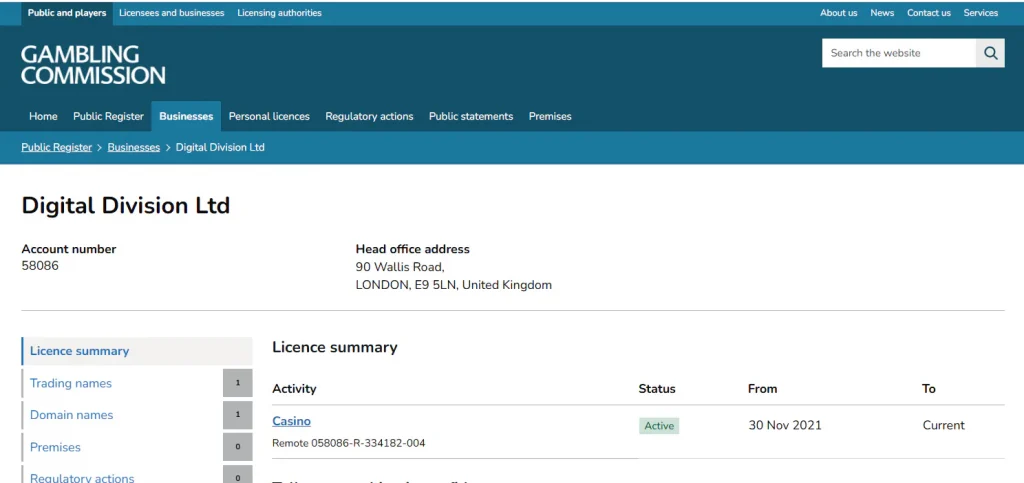
Digital Division Ltd licensing details. The UK Gambling Commission public register identifies Digital Division Ltd under account 58086. Its remote operating licence 058086-R-334182-003 is marked Active, with a start date of 30 November 2021. The linked domain record separately lists www.slotstemple.com as Active. The combination of operator, licence and domain is the useful check: a logo or an affiliate review alone does not prove that a particular website belongs to the registered business.
This UK-focused guide explains the licence in its correct geographical setting. The Gambling Commission’s ordinary Gambling Act 2005 jurisdiction covers Great Britain, meaning England, Scotland and Wales; Northern Ireland has a different gambling-law framework. A current registration establishes a regulatory relationship, not guaranteed winnings, instant withdrawals, an individual complaint outcome or an endorsement of any wager.
Table of Contents
- The operator, licence and domain
- Where to find the operator record
- What a remote operating licence establishes
- Great Britain and Northern Ireland are not interchangeable
- Age and identity checks are distinct from licence verification
- Safer-gambling controls published by the operator
- Account and payment protections
- Questions about the published record
- The scope of the operator licence
The operator, licence and domain
| Item | Published result | Why it matters |
|---|---|---|
| Registered business | Digital Division Ltd | Identifies the licensed legal operator, rather than only a trading name. |
| UKGC account | 58086 | Connects the separate register views to the same licensee. |
| Remote licence | 058086-R-334182-003; Active | Shows a published operating-licence record and its current status. |
| Licence start | 30 November 2021 | Gives the registered start date, not a claim about a brand launch. |
| Listed website | www.slotstemple.com; Active | Matches the actual website address to the licensed business. |
The operator’s UK terms also identify Digital Division Ltd as the owner and operator of the website and its tournaments. That is useful supporting material, while the Gambling Commission register remains the source for the actual UKGC licence number and current status. If a page displays a licence number without a link to an official register record, verify it independently rather than copying it into another review.
The regulator also publishes a separate regulatory-actions view. The regulatory-actions entry lists no recorded actions for this business. That entry concerns formal actions, not every customer complaint or future change. The published record can change, so the correct habit is to read its live entry.
Where to find the operator record
- Open the Gambling Commission’s official Digital Division Ltd licence summary. Read the business name and account number together.
- Find the remote operating licence in the summary, check its status and note the date you performed the check.
- Open the linked domain-names record and compare the actual website address character by character with www.slotstemple.com.
- If reviewing a promotional claim, open the operator’s current conditions separately. The registration record does not establish bonus eligibility, tournament rules or the value of an offer.
- If reviewing a transaction, preserve the relevant account, payment and event records rather than expecting the register to explain a personal balance.
This process catches an important distinction: the legal entity may have a different name from the brand on a page. It also guards against confusing a similarly named search result, advert or unrelated website with the registered domain. The register should be accessed directly through the regulator’s website, not through a graphic copied onto another site. An old image records what was visible at one point in time; it cannot replace a current status lookup.
What a remote operating licence establishes
The Gambling Commission’s remote casino licence information explains the licensing category for remote casino activity. Its public register links a specific operating business to its recorded permissions. The distinction from a land-based venue matters: a website’s licence record is not a generic statement that the same operator runs a physical casino or holds every possible gambling permission.
For a reader, registration makes it possible to identify the company against which relevant regulatory requirements are directed. These include policies for customer identity, complaint handling and safer gambling. It does not establish the outcome of any particular slot spin. Nor does an active licence tell you that every claimed payout window will be met in every case; payment checks, card processing and account verification are separate processes.
A licence record establishes operator status but does not measure game quality, payout speed or individual outcomes. The licence answers who the regulator records and which domain is attached. To understand products, read the Slots Temple game catalogue guide; to understand offer mechanics, read the Slots Temple bonuses guide. Those matters depend on the relevant product terms, not licence status alone.
Great Britain and Northern Ireland are not interchangeable
The website is written for a UK audience, but a UK heading should not silently turn every Great Britain rule into a claim about Northern Ireland. The Commission’s Northern Ireland remit explanation states that its Gambling Act 2005 jurisdiction covers England, Scotland and Wales. Northern Ireland’s general gambling framework instead sits under its own legislation. The Commission also explains that GB-based gambling equipment can give rise to a licensing requirement for a remote operator offering services in Northern Ireland without making the Commission the local regulator of that gambling activity.
That territorial distinction has practical consequences when reading claims about customer protections. The existence of Digital Division Ltd’s GB licence is a public record that anyone can inspect; the reach of a particular statutory protection or complaint route is a different question. A reader in Northern Ireland should check which contractual and regulatory provisions apply to their transaction rather than treating the words UK and GB as synonyms.
One connected scheme has a broader stated reach: GAMSTOP Online says its free online self-exclusion service covers UK residents in both Great Britain and Northern Ireland. That does not alter the Commission’s legal remit. A scheme’s eligibility and a regulator’s territory are separate facts.
Age and identity checks are distinct from licence verification
Slots Temple’s UK terms state that real-money games and tournaments require an account for a person aged 18 or over. They describe entering a name, address and date of birth for identity checking through a third-party service. The terms allow further information or documents to be requested when needed. An active operating licence therefore does not mean that a particular customer’s registration is already approved or that any submitted withdrawal must bypass checks.
For readers comparing the steps in detail, our registration and KYC guide distinguishes the initial details from later requests for evidence. It does not turn possible examples such as a passport or driving licence into a document list for every customer. From a consumer perspective, the useful checks are simple: use your own details, keep the account record consistent and retain correspondence if a specific information request becomes disputed.
Licence verification is also different from authentication. The domain’s presence in the register can help identify the genuine website, but it is still important to type or bookmark the correct address and avoid entering credentials into a lookalike domain. An official register entry cannot guarantee that every external message or search advert using the brand name is genuine.
Safer-gambling controls published by the operator
Slots Temple’s responsible-gambling help article, updated in August 2026, describes gross and net deposit limits, reality-check reminders, time outs and self-exclusion. Gross limits count deposits without allowing a settled withdrawal to replenish the allowance; net limits account for deposits minus settled withdrawals over the defined period. The operator states that limit periods follow UTC and that a request to raise a limit takes 24 hours and requires confirmation, while lowering it takes effect immediately.
These tools address different needs. A reality check reminds someone of elapsed playing time; a deposit limit governs funding according to its selected calculation; a time out temporarily closes access; self-exclusion addresses a more substantial decision to stop gambling. The operator’s help page describes time outs from 24 hours to six weeks and self-exclusion from six months to five years. Readers who want a multi-operator route can consult GAMSTOP directly.
These are published control options, not proof that gambling is free of risk. The operator’s own terms acknowledge the possibility of losing money. If a financial or time boundary matters, examine how a gross or net limit is calculated rather than choosing one based solely on the word ‘limit’. Also remember that free demo access, paid tournaments and real-money slot play are not the same transaction type.
Account and payment protections
- Payments and withdrawals
- The licence identifies the operator, but payment method availability and the status of an actual transfer come from the operator’s banking information and the customer’s transaction record. See the deposit methods guide for named-card requirements and the distinction between depositing and cashing out.
- Complaints
- An official route exists for raising an issue with the operator, followed by an independent dispute process for qualifying unresolved cases. Read the complaints and IBAS guide for the procedural sequence, evidence checklist and eight-week context.
- Games and odds
- Licensing does not turn RTP into a prediction for a single session. An RTP percentage is a long-run mathematical measure for a particular game configuration, not a guarantee of recovering a stake.
- Promotions
- The operator’s published offer or tournament rules determine eligibility and mechanics. A current licence does not promise that every visitor receives the same promotion.
These categories are intentionally separate because they answer different consumer questions. Combining them into an all-purpose ‘licensed therefore safe’ badge would conceal important specifics. A verifiable licence entry is useful precisely because it says something narrow and testable.
Questions about the published record
Is Slots Temple itself the legal licensee?
The brand’s UK terms name Digital Division Ltd as operator. The UKGC register records Digital Division Ltd under account 58086, and the domain list associates www.slotstemple.com with that account. The company name and trading website should be checked together.
Can a regulator record settle an individual withdrawal complaint?
No. The public register is for licence information. Raise a payment problem with the operator and follow its complaint procedure where necessary. Independent ADR is an escalation route for a qualifying unresolved dispute, not a feature of the licence-search page.
Does the licence say my gambling outcome will be fair or profitable?
It establishes a recorded licence and regulated operator. It does not predict individual results, confirm a future prize or make gambling a way to earn money.
Does the licence determine how deposited funds are protected?
No. Customer-funds disclosure is a separate matter from the active licence status. Read the current authoritative disclosure in the operator terms for the exact applicable statement; do not infer a particular protection category from a licence number.
Does the listed status stay the same indefinitely?
No. A licence status can change. The public register provides the latest licence and domain entries.
The scope of the operator licence
The UKGC register lists Digital Division Ltd’s active remote casino licence and its Slots Temple domain. The useful next step depends on the question: consult account terms for verification, transaction records for a payment issue, the operator’s complaint process for a dispute and the live register for status. Return to the Slots Temple UK review for the wider product context. The independent website does not operate casino accounts or handle individual complaints.