Slots Temple Registration and Identity Verification
 Available in GB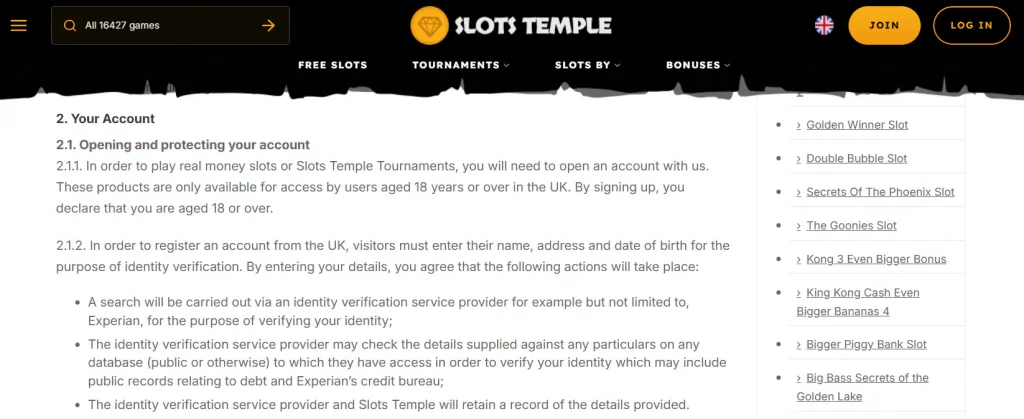
Updated 28 September 2026. Slots Temple’s UK real-money games and tournaments are intended for people aged 18 or over who complete its account checks. Registration requires accurate name, address and date of birth for identity verification. Its terms describe checks with a third-party identity service and allow additional evidence to be requested. A passport or driving licence is given as an example of possible extra identification, not as a fixed document list that everyone must upload. The operator can restrict gambling access until the necessary checks are complete.
Age, identity and payment ownership are distinct checks. A UK debit card used for a deposit must belong to the named account holder; being able to open a website or install an app does not bypass registration. Additional document requests take varying amounts of time, and the operator does not give one universal completion time for every account.
Table of Contents
- The registration sequence and its separate gates
- What Great Britain rules require before play
- What KYC documents might be requested?
- Payment-holder checks are not the same as age checks
- One account, correct details and secure access
- Safer-gambling controls belong to the account
- What to do when checks or account access stall
- Registration questions answered
The registration sequence and its separate gates
The operator’s UK terms, section 2.1, state that an account is needed for real-money slots and Slots Temple tournaments. For UK visitors, the initial personal details are name, address and date of birth. The operator says those details are checked using a third-party identity verification service, which can compare them with records available to it. Verification therefore involves more than a tick box declaring adulthood.
- Use the genuine operator service. Check the address or the provider of an official app before entering credentials or personal details.
- Enter your own details accurately. Use your legal identity, current address and genuine date of birth. A spelling or address mismatch can create questions that a correctly completed record would avoid.
- Allow the initial identity and age checks. The operator describes a database-based verification process. Submission is not proof that the result is already accepted.
- Respond to a specific request if needed. Extra evidence can concern identity, age, address, country of birth, occupation or authority to use a payment method.
- Confirm the account’s current status. Access to real-money services or tournaments can be restricted while the operator completes required checks.
The account process can vary when further identification is necessary. Buttons and questions may differ between a new registration and an existing account that needs more information. The operator does not specify a universal four-minute completion time or require the same two documents from everyone. Follow the request shown in your own account.
What Great Britain rules require before play
The UK Gambling Commission’s customer identity condition 17.1.1 requires applicable remote licensees to obtain and verify identity information before allowing a customer to gamble, including name, address and date of birth. Its remote age-verification code 3.2.11 separately requires age verification before a customer can deposit, gamble or access operator-provided free-to-play versions of gambling games. The requirements describe different safeguards, even though the initial registration process can address both.
These Commission rules govern Great Britain – England, Scotland and Wales. Northern Ireland has a distinct legislative and regulatory framework; a UK-facing brand’s product wording should not be used to claim that every GB rule automatically has the same legal basis there. Slots Temple’s own current terms describe access for UK adults. This distinction matters when comparing a commercial account rule with a particular regulator’s statutory remit, not when deciding whether to provide accurate details to the operator.
The identity condition also says that a withdrawal request must not become an excuse for demanding information which the operator could reasonably have obtained earlier, while preserving requests required by another legal obligation. That is not a promise that further checks will never occur. It means the timing and rationale of an individual new request matter. If asked for evidence at cash-out, ask what requirement applies and use the official document route, rather than assuming any request is automatically invalid or any delay is automatically justified.
What KYC documents might be requested?
Section 2.1.4 of the current operator terms expressly mentions a passport or driving licence among potential further documents. Section 2.1.3 allows requests for information supporting identity, age, address, country of birth, occupation or authorisation to use a debit card or other payment method. These are examples and categories of evidence, not a promise that an exact combination is mandatory for every customer. The operator may conduct checks itself or through third parties.
A useful distinction is between the initial details entered on a form and a later request for documentary proof. The first consists of data such as the name and address; the second involves evidence when the operator needs to substantiate a point. If the operator asks for one specific item, do not automatically send an unrelated bundle of documents. Read the reason and submission method in the authenticated account or official support correspondence, and clarify any uncertainty before transmitting sensitive personal information.
| Area | Published requirement or possibility | Practical check |
|---|---|---|
| Core registration | Name, address and date of birth | Check spelling, date and present address before submission. |
| Identity and age | Additional documents can be requested; passport and driving licence are examples | Supply the item actually requested for the account rather than assuming every customer needs the same documents. |
| Other personal context | Address, country of birth or occupation evidence can be requested | Read the operator’s specific explanation and secure delivery route. |
| Payment ownership | Operator may check authority to use a debit card or other payment method | Use only payment sources in the account holder’s name. |
| Completion time | No universal exact public KYC processing figure established here | Use the account status or official case response rather than a promised clock. |
The public terms do not establish a guaranteed queue position, a single processing time for every document or an exhaustive accepted-file specification. Those details should come from the current authenticated instructions when actually requested. This avoids two opposite mistakes: claiming that Slots Temple has no identity check and claiming that every legitimate customer faces an identical document process.
Payment-holder checks are not the same as age checks
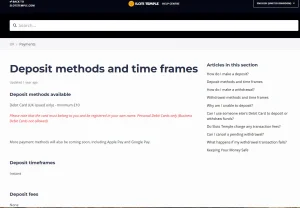
Slots Temple’s published UK funding route is a personal UK-issued debit card, with a £10 minimum deposit. Its terms require the source of payment to be held in the customer’s name and prohibit UK credit-card deposits, including indirect credit-card funding. A verified date of birth does not make a third party’s card acceptable; likewise, possession of a debit card does not prove age or identity. The operator can check these matters separately.
Where a depositor later withdraws, the published route uses the same account-holder card. If the named owner differs from the Slots Temple account holder, the terms describe the possibility of invalid deposits and associated winnings being void. That is why a shared household account, relative’s card or convenience payment from someone else should not be treated as interchangeable with the player’s own verified method. Our deposit methods guide covers the current method and limit mechanics; the withdrawal time frames guide explains the separate operator and bank processing stages.
If a new evidence request appears after a payment request, record the request date, what was asked for and whether the cardholder name already matches the account. Do not put a full card number, CVV or identity image in an ordinary unsolicited email. Where the operator offers a designated secure upload route, follow its instructions. A payment problem needs an account-specific explanation from the operator because only it can identify which requirement remains outstanding.
One account, correct details and secure access
The terms prohibit an existing customer from opening another Slots Temple account. They also identify coordinated use of multiple accounts for tournament leaderboard advantage as a breach that can lead to withheld winnings and closure. Changing from desktop to a mobile browser or the official Apple listing does not create a new entitlement to register again. Use the same authorised account across channels; see our iOS app and mobile access guide for identity checks on a device.
The operator says users must keep usernames and passwords confidential, should change passwords regularly and should report account-detail errors promptly. For a login issue, check that the address is genuine and that you are accessing the existing account before attempting a new registration. A request for credentials through an unexpected message should be treated differently from the operator’s normal authenticated login. If you suspect compromise, use the published customer service route and explain what changed without pasting a password or one-time code into your enquiry.
When a stored name or address needs correction, contact the operator instead of opening another account with revised information. Keep the correction trail so the original account can be identified. The aim is an accurate, single record against which the operator can perform its checks. This is especially relevant for tournaments, where using more than one identity to create extra entries is not simply a technical workaround: the terms expressly address collusion and duplicate-account play.
Safer-gambling controls belong to the account
Slots Temple’s current published account controls include deposit limits, reality-check reminders, time-outs and self-exclusion. Its August 2026 help material describes gross and net deposit-limit options; the two measure activity differently, so check which one is selected rather than inferring that a withdrawal automatically restores every deposit allowance. An account-level setting should not be treated as a device-level setting that disappears when a customer switches from browser to app.
The terms identify an account Player Protection area and customer service as routes for self-exclusion, and refer to GAMSTOP for broader online exclusion. A time-out is a temporary pause, while self-exclusion is a different commitment intended to block gambling access for a specified period. If gambling is causing harm, use these tools rather than treating a new device or second registration as a way around a restriction. The UKGC licence record guide sets out the wider GB context and how to verify the actual operator record.
Registration also does not imply that a particular promotion, tournament format or prize is available to everyone at every moment. Slots Temple does not publish a conventional welcome match and instead has free and paid tournament activity with its own rules. The Slots Temple bonuses guide distinguishes those products from partner offers. Identity checks determine account access; an individual event’s entry and scoring conditions are separate matters.
What to do when checks or account access stall
Begin with the current message in the authenticated account. Identify whether the operator is requesting missing core details, additional identification, payment-holder evidence or information about a separate security issue. Make a dated record of what you submitted and through which official channel. If the operator has not supplied a clear document request, seek clarification before sending a wider collection of personal files. An unspecific “verification pending” message does not reveal which item is the problem.
The operator publishes support by email at [email protected] and a web ticket or form. State the account reference if one is supplied, the relevant dates and the exact wording of the request; explain which outcome you need, such as identifying an outstanding item or correcting recorded account details. Do not send sensitive documents in response to a social-media message merely because it carries the operator’s logo. Retain official correspondence if the issue later needs escalation.
If ordinary support cannot resolve a substantive account dispute, the published complaints procedure provides a formal route and names IBAS for independent dispute resolution following the operator process. A request for a status update and a formal dispute are different stages. Our complaints and IBAS guide explains the sequence, including the relevant GB framework, without promising that an external body will decide an individual case in a particular way.
Registration questions answered
Can someone under 18 use the free games?
The operator’s UK real-money account terms require adulthood, and the GB remote age-verification code covers operator-provided free-to-play gambling games as well as deposits and gambling. A free demo is not an exemption from the age-verification requirement.
Does everybody have to upload a passport?
No fixed universal upload list is established by the terms. Passport and driving licence are expressly named examples of documents that can be requested for further checks, while the initial registration details are name, address and date of birth.
Is verification guaranteed to finish immediately?
The operator does not give one completion time for every case. Check the request in your account and contact official support when more information is needed.
Can I create another account if I cannot sign in?
The operator’s terms prohibit additional accounts for existing customers. Use the account recovery or official support pathway rather than attempting a duplicate registration.
For the operator overview, including the difference between real-money games, demo play and third-party promotional material, return to the Slots Temple UK review. Accurate identity details, a personally held payment source and documented follow-up are more useful than any promise of effortless or instant KYC.